Every few months a new headline arrives: "AI Will Replace Programmers." Every few months, it doesn't happen.
This isn't a coincidence. It's not lag. It's a fundamental misunderstanding of what software development actually is.
What AI Is Very Good At
Let's be honest first. AI code generation tools — GitHub Copilot, Claude, GPT-4o — are genuinely impressive. They can:
- Complete boilerplate at speed no human matches
- Translate requirements written in plain English into working code
- Find bugs, suggest refactors, and explain unfamiliar codebases
- Generate unit tests from function signatures in seconds
If your definition of "software development" is typing code, then yes, AI has made a significant dent.
But that's not what software development is.
Software Development Is Problem-Solving, Not Code-Typing
The hardest parts of building software have nothing to do with syntax.
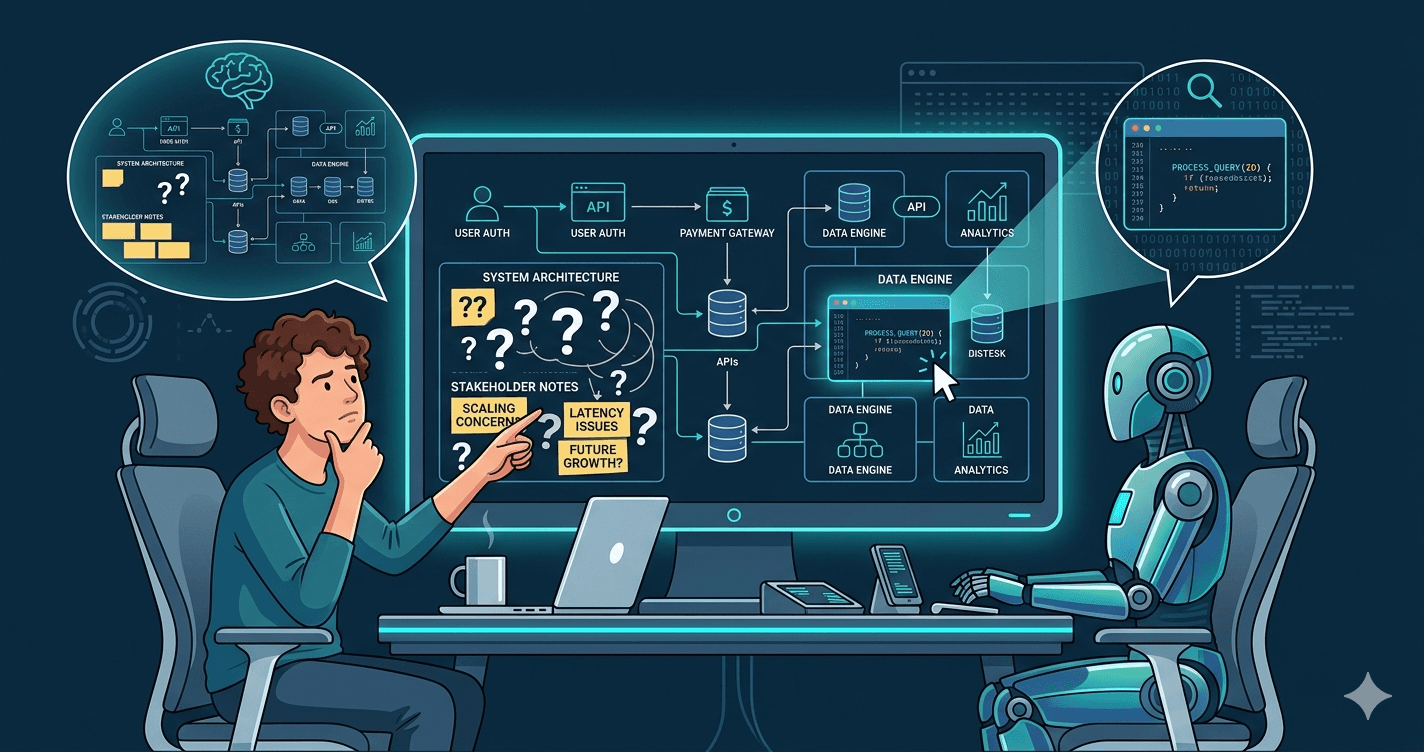
What problem are we actually solving? A client says "we need a dashboard." What do they mean? What data matters to them? What decisions will this dashboard drive? Getting this wrong and building the wrong thing is the most expensive mistake in software — AI cannot have the stakeholder conversation that prevents it.
What are the constraints? Technical debt, team skill sets, budget, timelines, regulatory requirements, existing integrations. A senior developer holds all of this context simultaneously and makes tradeoffs. AI sees the code; it doesn't see the organisation.
What are the second-order effects? Every architectural decision creates consequences down the line. A developer who has shipped and maintained systems for years carries intuition about which shortcuts cause pain in six months. AI has no skin in the game — it won't be there to maintain what it builds.
The Context Problem
AI models are stateless across the lifetime of a project. They know what you tell them in the current conversation. They don't know:
- Why a particular workaround was introduced three years ago
- That the client's IT team blocks port 8080 on prod
- That the "simple" feature request touches a payment flow that must not change before the upcoming audit
- That the last developer left undocumented assumptions scattered across the codebase
Software projects accumulate context over months and years. Developers are the living memory of that context. No AI tool today — or on the current architectural trajectory — accumulates that kind of institutional knowledge organically.
Judgment Under Ambiguity
Real requirements are ambiguous. "Make it faster" — faster how? Perceived load time? Actual throughput? Under what traffic conditions?
"It should work like Stripe" — which part of Stripe? Their checkout flow? Their API design? Their pricing model?
Turning ambiguity into precision is a skill that requires curiosity, domain knowledge, and the ability to ask the right follow-up questions. AI answers what you ask. Developers ask what you should have asked.
The Integration and Systems Problem
Any non-trivial software system integrates with other systems. Third-party APIs, legacy databases, hardware, internal microservices written by teams in different time zones with different standards. AI generates code in isolation. It doesn't know that your auth service returns a non-standard JWT format, or that your legacy ERP has an undocumented rate limit that only surfaces under load on the third Tuesday of every month.
Developers debug systems. AI debugs code. There is a meaningful difference.
Ethics, Accountability, and Trust
When software makes a consequential decision — a loan approval, a medical alert, a fraud flag — someone has to be accountable for it. That accountability cannot rest with an AI tool. It rests with the humans who designed, built, reviewed, and deployed the system.
Developers are not just builders. They are the people who raise a hand and say "this behaviour is wrong" or "this design creates a risk we haven't thought through." That kind of moral agency requires a human.
AI Makes Good Developers Better
The most accurate framing is not AI vs developers. It's AI as leverage.
A developer who uses AI tools well can do in a day what previously took a week. That doesn't eliminate the need for developers — it changes what developers spend their time on. More time on architecture. More time understanding the problem. More time reviewing what the AI produced and catching what it got wrong.
AI raises the floor of what a single developer can build. It raises the ceiling of what a great developer can build even higher.
What This Means for the Profession
The demand for developers who can only type code to spec will shrink. The demand for developers who can think, communicate, architect, judge, and lead — while using AI as a force multiplier — will grow.
The advice for anyone in or entering the profession is the same as it has always been: understand the fundamentals deeply, develop your communication skills, stay curious about the problem domain, and keep learning.
AI is the most powerful tool developers have ever had. Tools don't replace craftspeople. They separate the ones who master them from the ones who don't.
Software development was never about the typing. It was always about the thinking. And thinking, for now and for the foreseeable future, remains a human advantage.