A Developer's Honest Take
Let me be upfront: I build software for a living. I run services on cloud infrastructure. I'm not against technology — I depend on it.
But when I see headlines celebrating India becoming the next global data center hub, I don't feel excitement. I feel the need to ask a question that isn't being asked loudly enough:
Who does this actually benefit?
75 Years of Independence — and Still No Drinking Water in Villages
India celebrated 75 years of independence in 2022. And yet, today, there are still villages where clean drinking water is not guaranteed. Basic sanitation remains a distant goal for millions of people.
When the same country is being courted to host some of the world's largest electricity consumers, I think it's fair to stop and ask: are we investing in the right things? Are the people making these decisions living with the same realities as the rest of India?
This isn't anti-progress. It's a question of priority.
The Electricity Problem Nobody Wants to Talk About
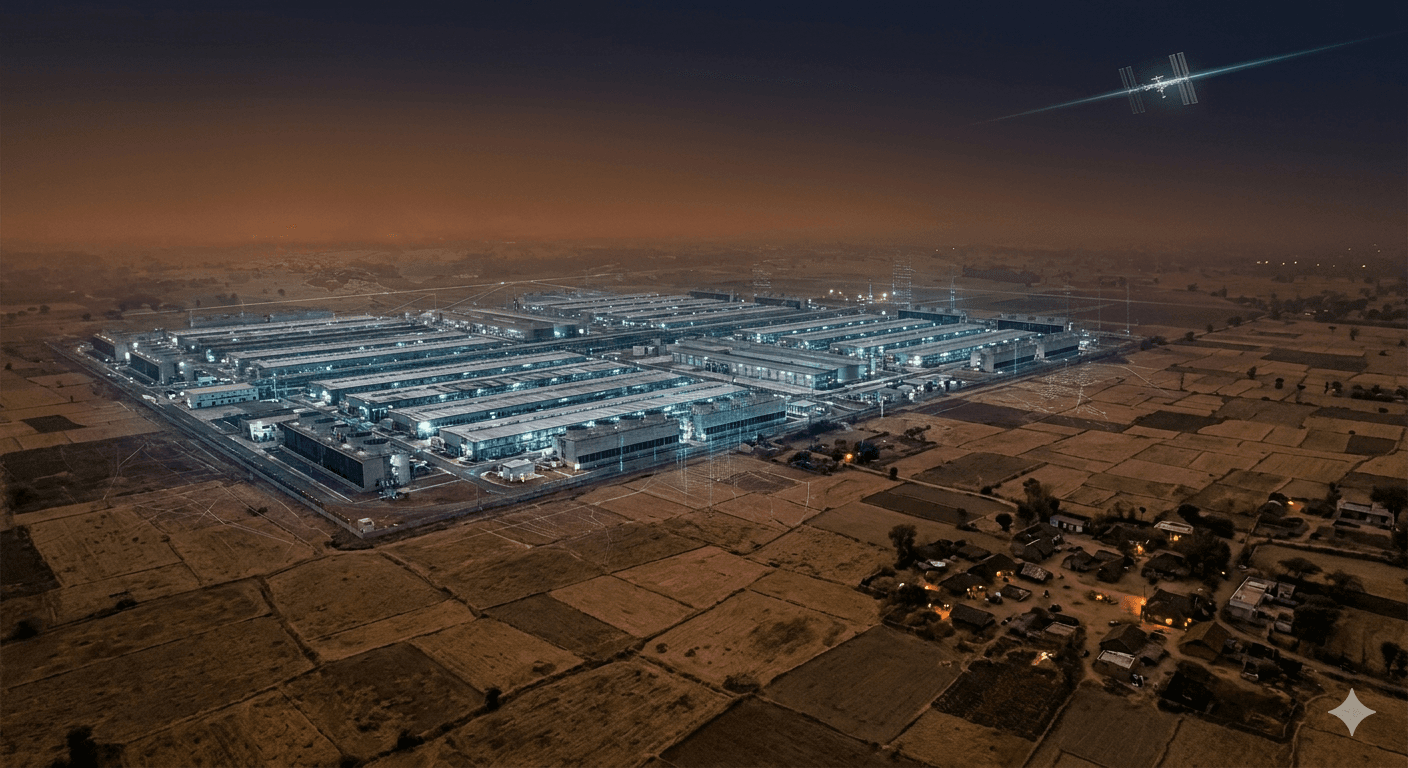
Data centers are not small consumers of power. A single large-scale data center can consume as much electricity as a small city. And the hard truth is: India's grid still runs heavily on coal.
We haven't solved reliable 24/7 power for homes and hospitals in tier-2 and tier-3 cities. Rolling blackouts are still a reality. And now we're inviting infrastructure that requires uninterrupted, massive power draw — backed by diesel generators as failover.
Where does that electricity come from? What does that do to an already strained grid? Who pays for the upgrades — and who gets left out?
Filling Pockets, Not Building Infrastructure
Let's talk about who benefits from these data centers.
The land is cheap in India. Labour is cheap. Regulatory friction — at least the kind that would slow things down in Europe or North America — is lower. Tax incentives are generous. And the local government is eager to announce "investment" numbers that look good on paper.
What do Indian citizens get in return? Some jobs in construction and maintenance, yes. But the data being processed, the revenue being generated, the intellectual value — that flows back to headquarters in Seattle, Mountain View, or Redmond.
This is not investment in India. It is investment using India. There's a difference.
The Environmental Cost We're Expected to Ignore
Here is the thing that bothers me most.
Google, Microsoft, Amazon — these companies face intense environmental scrutiny in Europe and North America. Citizens there hold their governments accountable. Activists sue. Regulations exist. Building a data center in Germany means meeting serious environmental standards.
India is different. And these companies know it.
The heat output from large data centers is significant. The water consumption for cooling is enormous. The carbon footprint — especially on a coal-dependent grid — is real. But here, those concerns are easier to minimize, delay, or simply ignore.
I don't think this is a coincidence. I think it's a calculation.
We as Indians are often so eager to be seen as "developed" and "on the global stage" that we accept tradeoffs we shouldn't. The environment pays. Future generations pay. The companies move on.
A Different Vision: Think Beyond the Ground
Here's where I want to end — not with criticism, but with a challenge.
India has ISRO. We successfully landed on the south pole of the Moon. We launched a mission to Mars on a budget smaller than a Hollywood film. We have real space capability.
What if, instead of racing to become the cheapest place to host other people's data on the ground, India invested in becoming the first country to seriously explore space-based computing infrastructure? Low Earth Orbit data processing. Solar-powered orbital servers. Data architecture that doesn't burn coal or heat our cities.
That would be genuinely innovative. That would be a legacy worth building.
Our Responsibility as Citizens
This is where I want to be direct — not just as a developer, but as an Indian citizen.
It is easy to leave these conversations to politicians, bureaucrats, and business leaders. It is easy to assume that someone else will ask the hard questions, that someone else will push back, that someone else will demand better.
But that attitude is exactly how we end up with decisions that benefit a few and burden everyone else.
As citizens, we have a responsibility to stay informed about what is being built in our country, on our land, consuming our resources — and to speak up when the trade-offs are not being honestly disclosed. We don't have to be scientists or environmentalists to ask: where does this electricity come from? Who profits from this? What does our city look like in 20 years if we keep saying yes to everything?
The governments of other countries are held accountable on environmental issues because their citizens demand it. That accountability didn't come from the top down — it came from ordinary people who refused to stay quiet.
India deserves the same. Our rivers, our air, our farmland, our electricity grid — these belong to all of us, not just to whoever can afford a meeting with a government minister.
Raising these questions isn't being anti-development. It's the most patriotic thing we can do.
Closing Thought
I'm not saying no to technology. I'm saying yes to asking hard questions before we say yes to everything.
Data centers in India will happen. They probably already are. But I'd rather we go in with our eyes open — knowing who benefits, what we're trading, and whether we're actually building the future we want, or just making it cheaper for someone else to build theirs.
We have 75+ years of being told that foreign investment is development. Maybe it's time we defined development for ourselves.