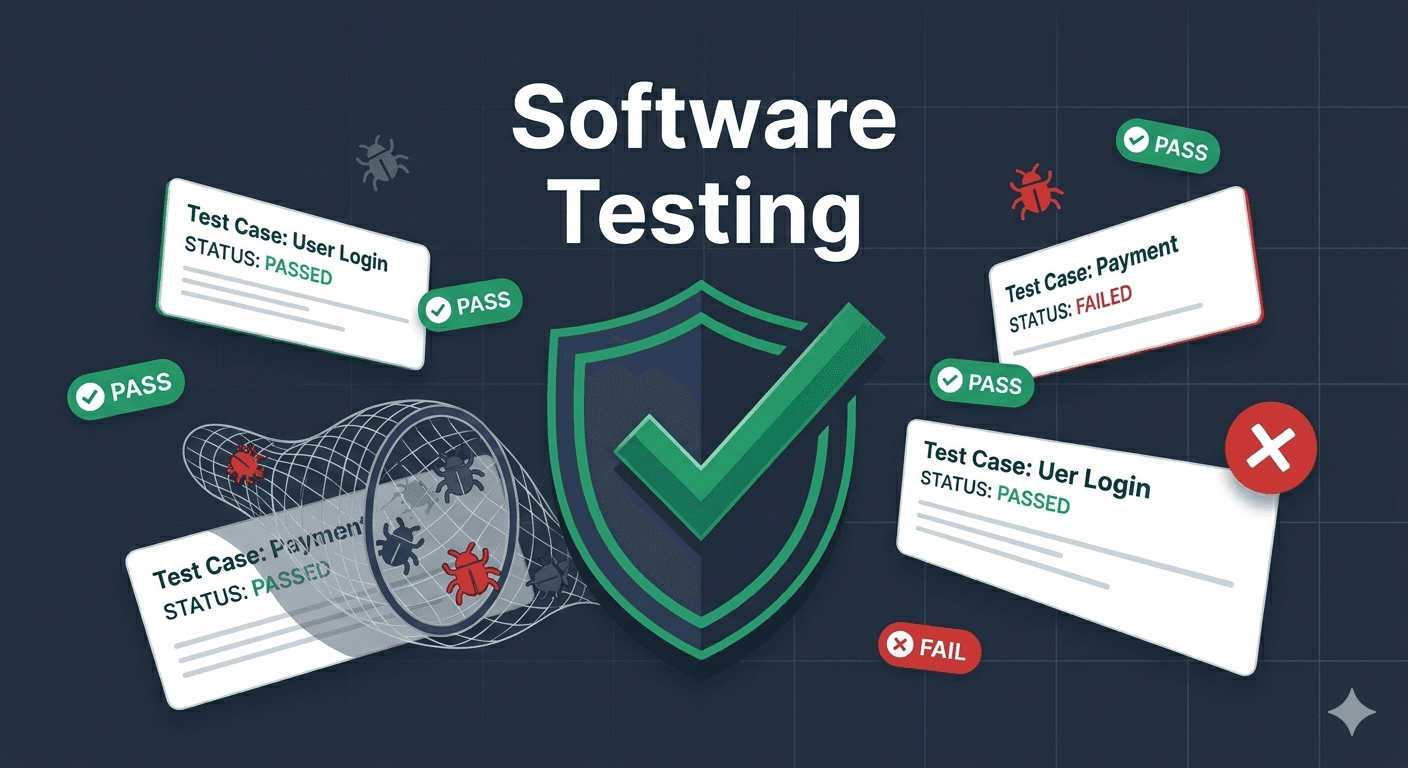
Every software team has a version of the same story: a bug slips through, reaches production, and suddenly a five-minute fix turns into an all-hands incident. The root cause is almost always the same — testing was treated as optional.
In 2026, with deployment cycles measured in hours and user expectations at an all-time high, software testing isn't a phase you schedule at the end. It's a discipline woven into every stage of how you build.
What Software Testing Actually Is
Software testing is the process of evaluating a system to detect differences between expected and actual behaviour. That definition sounds simple. The practice is anything but.
Testing covers a wide spectrum:
- Unit tests — verify individual functions or components in isolation
- Integration tests — verify that modules work correctly together
- End-to-end tests — simulate real user flows from browser to database
- Performance tests — measure response times, throughput, and stability under load
- Security tests — identify vulnerabilities before attackers do
- Regression tests — ensure new changes don't break existing behaviour
Each type catches a different class of bug. Skipping any of them leaves a gap.
The Cost of Not Testing
The numbers are well-documented. IBM's Systems Sciences Institute found that a bug caught in production costs 6x more to fix than one caught during development — and up to 100x more than one caught during design.
But the cost isn't only financial. A production bug can:
- Erode user trust in minutes
- Expose sensitive customer data
- Trigger compliance violations
- Damage your brand permanently
Consider a concrete example: a SaaS product with a billing integration. A missed edge case in the payment flow — say, a race condition when two users update the same subscription simultaneously — can silently double-charge customers. By the time support tickets surface the issue, you've potentially violated PCI compliance, lost customer trust, and created a reconciliation nightmare. A single integration test covering concurrent subscription updates would have caught it.
Testing is not overhead. It's risk management.
Shift Left: Test Earlier, Not Later
The most impactful change any team can make is to move testing earlier in the development cycle — a practice called shift-left testing.
Instead of handing off a completed feature to QA at the end of a sprint, developers write tests as they write code. Product and design validate acceptance criteria before a line is written. Automated checks run on every commit.
The result: bugs are caught when they're cheapest to fix, not when they're most expensive.
What shift-left looks like in practice
Requirement phase    → Acceptance criteria reviewed by dev + QA together
Development phase    → Unit tests written alongside code (TDD or test-after)
Pull request         → CI runs unit + integration tests; PR blocked if red
Staging deploy       → E2E tests run against staging environment
Production deploy    → Smoke tests verify critical paths post-deploy
The key insight is that QA isn't a gate at the end — it's a perspective present throughout. When a tester reviews acceptance criteria before development starts, they catch ambiguity and edge cases that would otherwise become bugs.
Automation vs. Manual Testing
A common misconception is that automated testing replaces manual testing. It doesn't — it complements it.
Automated testing excels at:
- Running regression suites on every build
- Testing repetitive, data-driven scenarios
- Catching regressions introduced by refactors
- Running thousands of checks in minutes
Manual testing excels at:
- Exploratory testing — finding bugs that scripts wouldn't think to look for
- Usability and UX evaluation
- Edge cases that require human judgement
- Testing new features before automation is written
A mature QA practice uses both, strategically. The rule of thumb: if you'll run the same check more than three times, automate it. If it requires judgement, intuition, or creative thinking, keep it manual.
The Testing Pyramid
Not all tests are created equal. The testing pyramid is a model that helps teams allocate their testing effort:
         /  E2E  \          ← Few, slow, expensive
        /----------\
       / Integration \      ← Moderate number, medium speed
      /----------------\
     /    Unit Tests     \  ← Many, fast, cheap
    /____________________\
Unit tests form the base — they're fast, isolated, and cheap to write. A well-tested function with 10 unit tests runs in milliseconds and catches most logic errors.
Integration tests verify that components work together. They're slower (they might hit a database or call an API) but catch a class of bugs that unit tests miss: serialization issues, incorrect query behaviour, misconfigured middleware.
E2E tests simulate real user behaviour. They're the slowest and most brittle, but they're the only tests that verify the full stack works together. Use them sparingly — cover your critical paths (login, checkout, data export) and resist the urge to E2E-test everything.
Teams that invert the pyramid — many E2E tests, few unit tests — end up with slow CI pipelines, flaky test suites, and developers who stop trusting the results.
Building a Testing Culture
The technical side of testing is learnable. The harder challenge is cultural. Testing only works when the whole team — developers, product managers, designers, and leadership — treats quality as a shared responsibility.
A few practices that help:
Definition of Done includes tests. A feature isn't complete until it has test coverage. No exceptions.
Tests live in the same repo as the code. Not in a separate system nobody looks at.
Failures block deployment. If a test fails, the pipeline stops. This is non-negotiable.
Bugs are learning opportunities. When something reaches production untested, the team asks why — not who. The goal is to close the gap, not assign blame.
Track test execution time. A test suite that takes 45 minutes to run is a test suite that developers skip locally. Keep unit tests under 2 minutes, integration tests under 10. If they're slower, parallelize or trim.
Where to Start
If your project has minimal test coverage today, the path forward isn't to stop everything and write tests for your entire codebase. That's paralysis.
Start here:
- Write tests for new code from today. Every new function, every new feature gets a test. Don't backfill old code yet — just stop the bleeding.
- Cover your most critical paths first. Payments, authentication, data writes — wherever a bug causes the most damage. These are your highest-ROI tests.
- Set up CI to run tests automatically. A test that only runs locally is a test that gets skipped. GitHub Actions, GitLab CI, or Azure Pipelines — the tool matters less than the habit.
- Add a test when you fix a bug. Every bug that reaches production becomes a regression test. This ensures the same bug never ships twice, and steadily grows your coverage where it matters most.
- Track coverage as a metric, not a goal. 100% coverage doesn't mean zero bugs. Meaningful coverage — focused on business logic and critical paths — does.
Final Thought
Software testing doesn't slow you down. Bugs in production slow you down. Testing is what lets you move fast with confidence — shipping features instead of hotfixes, building trust instead of managing incidents.
The teams that treat quality as built-in, not bolted-on, are the ones that ship reliably, retain users, and compound their advantage over time.